The Documents I Ask For Before a Nonprofit Spends a Dollar on Grant Writing
Short Answer
Before you spend money on a grant writer, you need the foundational documents that writer requires on day one. Gitta Williams walks through the exact documents — legal, tax, federal registration, governance, program, and financial — that California nonprofits must have in place before grant writing can begin.
The Real Question Behind the Search
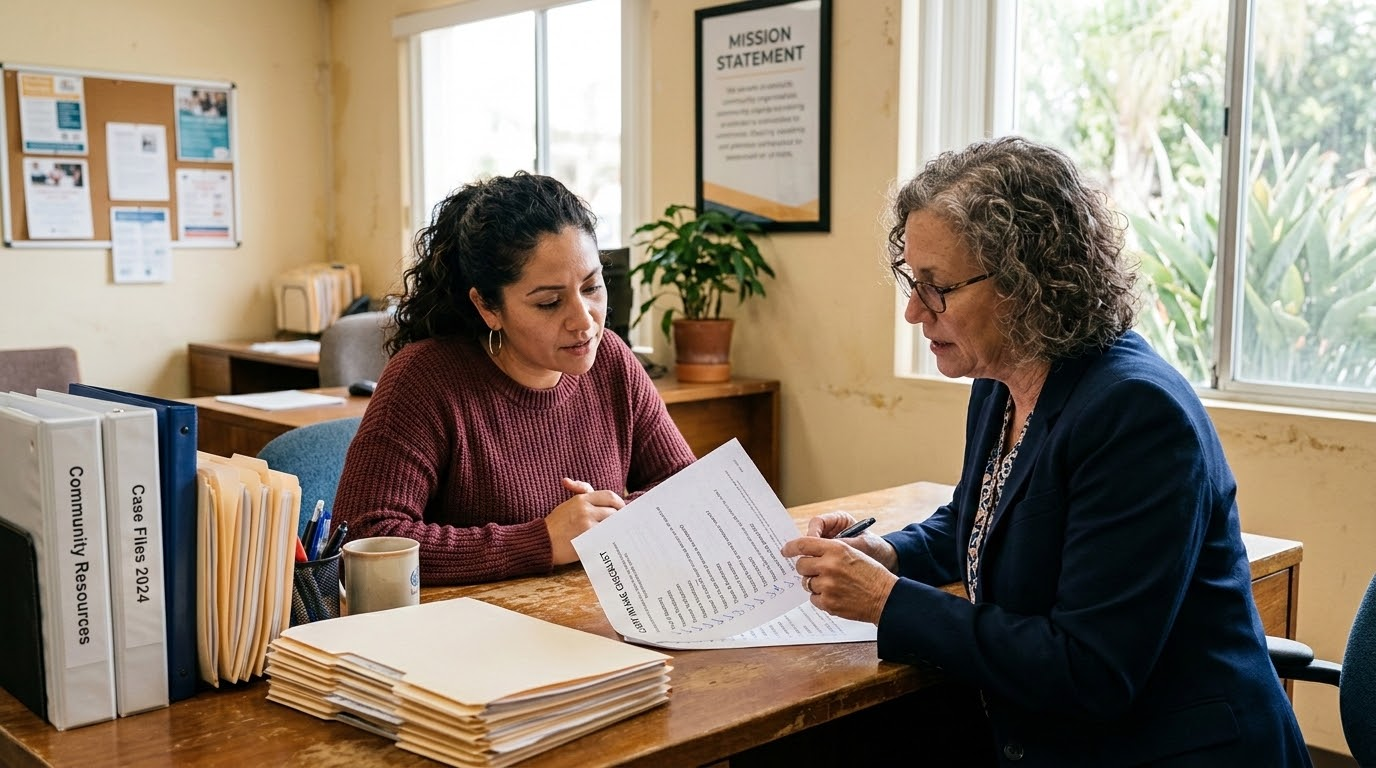
When a nonprofit leader reaches out to me about hiring a grant writer, the first thing I do is not talk about writing. I ask about documents.
Not because I want to slow anything down. Because without the right foundational documents already in place, a grant writer cannot do their job effectively — and the nonprofit leader ends up paying for work that cannot move forward.
I see this pattern frequently among organizations in Moreno Valley, the Inland Empire, and Riverside County. A founder is motivated. The program is real. The deadline feels urgent. And the instinct is to hire someone to write the proposal and get the money. But the grant writer shows up and immediately needs things the organization does not have — and suddenly the timeline, the budget, and the opportunity are all at risk.
This article is about getting ahead of that problem before it costs you anything.
Why Documents Come Before the Grant Writer
A grant writer's job is to communicate your organization's mission, program, and capacity in a way that convinces a funder to say yes. But they can only communicate what already exists in writing.
If your articles of incorporation are buried in a filing cabinet, your program budget has never been put on paper, and your expected outcomes are still living in your head — the writer cannot create those things for you. They are document preparers and proposal writers, not organizational architects. Without your foundational documents, they are guessing. And funders can tell.
Before you spend money on grant writing, the question to ask is simple: do I have the documents a grant writer will need on day one?
The Master Document List: What I Need Before Grant Writing Can Begin
| Document Category | Specific Document | Why It Matters to a Grant Writer |
|---|---|---|
| Legal Formation | Articles of Incorporation | Proves the nonprofit legally exists as an entity |
| Legal Formation | Statement of Information (filed with CA Secretary of State) | Confirms current registered agent and entity status |
| Tax Status | IRS Determination Letter (501(c)(3)) | Required by nearly every private and public funder |
| Tax Status | State Tax-Exempt Status (California FTB) | Many CA funders verify both federal and state status |
| Federal Registration | SAM.gov Registration | Required for federal grants and many government-funded opportunities |
| Federal Registration | UEI Number (Unique Entity Identifier) | Federal grant applications cannot be submitted without it |
| Transparency | Candid.org / GuideStar Profile (active) | Funders verify this before opening a proposal |
| Governance | Board Roster (current, with roles) | Funders review who is governing the organization |
| Governance | Mission and Vision Statements (written) | Every grant narrative begins here |
| Program | Written Program Description | The who, what, when, where, and why — in writing |
| Program | Work Plan | Shows funders how and when the program will be delivered |
| Program | Expected Outcomes (documented) | Funders fund results, not activity |
| Financial | Operating Budget | Shows the full financial picture of the organization |
| Financial | Program Budget (line-item) | Specific cost of running the grant-funded program |
These are the foundational pieces a grant writer needs before meaningful work can begin. Without them in writing, the writer cannot accurately represent your organization to a funder.
What Each Document Does and Why It Cannot Be Skipped
Articles of Incorporation and Statement of Information
These two documents prove your nonprofit legally exists. Your articles of incorporation are the founding document filed with the California Secretary of State. Your statement of information keeps your entity record current and must be filed on a regular schedule. If either is missing or outdated, a funder cannot verify your legal standing — and many will not proceed past that point.
IRS Determination Letter and State Tax-Exempt Status
Most private foundations and public agencies require 501(c)(3) status before they will accept an application. Your IRS determination letter is the federal proof. But in California, you also need to apply separately for state tax-exempt status through the Franchise Tax Board. I see founders regularly who have their IRS letter but never completed the California filing — and that gap becomes a problem the moment they approach a state or regional funder.
SAM.gov Registration and UEI Number
If your organization ever plans to pursue federal grants or work with government-funded programs, you need to be registered in SAM.gov and hold a current Unique Entity Identifier. This registration cannot be done overnight — it takes time to process. If you wait until a federal deadline is approaching, it will likely be too late. Getting this done in advance is part of genuine grant readiness.
Candid.org Profile
Candid — formerly GuideStar — is where funders go to verify that a nonprofit is legitimate. An active Candid profile, especially one with a Seal of Transparency, signals to funders that your organization is organized and accountable. Many regional funders in the Inland Empire check this before they even open a proposal. If your profile is blank or out of date, it creates doubt before the writer's first sentence is ever read.
Board Roster, Mission, and Vision Statements
These are the governance and identity documents that tell a funder who you are and who is accountable. Your board roster should list current, named members with their roles. Your mission and vision statements need to be written down — not recalled from memory during a conversation. Every grant narrative I have ever worked on begins with these documents.
Program Description, Work Plan, and Expected Outcomes
This is where I see the biggest gaps. A program description tells a funder the who, what, when, where, and why. A work plan shows them how and when it happens. Expected outcomes tell them what will change as a result. Grant writers need all three in writing before they can build a proposal that holds together under funder review.
Operating Budget and Program Budget
Every grant is different in what it asks for financially — some want an operating budget, some want a program-specific budget, and some want both. What none of them want is a guess. I recommend that before pursuing any grant, your organization has a current operating budget and a line-item program budget that reflects the true cost of running your program at full capacity.
What Happens When These Documents Are Missing
When the foundation is incomplete, the consequences are predictable — and they show up at the worst possible moment.
| What Is Missing | What Actually Happens |
|---|---|
| No IRS determination letter or state exemption | Funder disqualifies the application before review begins |
| No SAM.gov registration or UEI number | Federal grant cannot be submitted — registration takes weeks to process |
| Candid profile is blank or outdated | Funder verification fails — proposal may be dismissed before it is read |
| Program description only exists verbally | Grant writer cannot accurately represent the program — narrative lacks specificity |
| No written program budget | Budget section of the application is estimated or incomplete — a major red flag for funders |
| Board roster is outdated or missing | Funder cannot confirm who governs the organization — governance section fails |
| Expected outcomes not documented | Proposal cannot demonstrate measurable impact — most funders require this |
| Missing operating budget | Funder cannot assess organizational financial health or sustainability |
The California-Specific Gap I See Most Often
The single most common document gap I encounter with nonprofits in Southern California is this: the founder has their federal 501(c)(3) determination letter from the IRS — and they stopped there.
California requires a separate state tax-exempt filing with the Franchise Tax Board. It also requires registration with the California Attorney General's Registry of Charitable Trusts if the organization solicits or receives donations. These are separate from the IRS process. They are not automatic. And they are checked by California-based funders, county agencies, and regional foundations before applications are evaluated.
If your organization shows up as delinquent or unregistered in the California Registry, a grant writer's best proposal will not save the application. The compliance issue must be resolved first.
Common Mistakes I See Before Nonprofits Hire a Grant Writer
Mistake 1: Assuming the grant writer will gather the documents for you.
Grant writers write. They do not form your organization, file your state exemption, build your budget, or document your outcomes. Those are your organizational responsibilities. A grant writer who agrees to work without those documents is either guessing or charging you for work that has to be redone later.
Mistake 2: Waiting until a deadline appears to get organized.
I hear this often: a grant cycle opens, the deadline is four weeks out, and the founder calls looking for a writer immediately. Four weeks is not enough time to produce foundational documents, build a program budget, document outcomes, and write a competitive proposal. Readiness has to come before the deadline, not during it.
Mistake 3: Thinking a strong verbal pitch replaces written documentation.
Every founder I work with can describe their program with passion and clarity in conversation. That is not what a grant application requires. A funder reading your proposal has never heard your pitch. They are reading documents. What you can say in a room does not transfer to paper unless it is already written down.
Mistake 4: Overlooking the Candid profile and SAM.gov registration.
These two items are easy to overlook because they feel administrative rather than substantive. But they are the first things many funders check. A missing Candid profile or an unregistered SAM.gov entity can eliminate an application before a single word of the proposal is read.
Quick Answers
What is the single most important document to have before hiring a grant writer?
Can a grant writer help me create my program description and budget?
What is a UEI number and do I really need one?
What is Candid and why do funders check it?
How long does it take to get all these documents in order?
What if I already hired a grant writer and we discovered documents are missing?
Before You Hire a Grant Writer, Check Your Documents First
Before you spend time, money, or energy pursuing your next grant, take The Document Pro’s Grant Readiness Checklist. It will show you exactly which documents are in place, which are missing, and which gaps need to be resolved before a grant writer can do their best work for your organization.
Disclaimer: This article is for educational and organizational planning purposes only. It does not provide legal, tax, financial, or grant approval advice and does not guarantee funding, eligibility, or funder acceptance.