What Funders Are Actually Looking For — And Why Good Record-Keeping Is the Real Answer
Short Answer
Foundations look closely at your financials, your governance records, and your ability to document what you said you would do. Gitta Williams explains the five trust pillars funders evaluate before releasing grant funds — and what Inland Empire nonprofits must have in place before they apply.
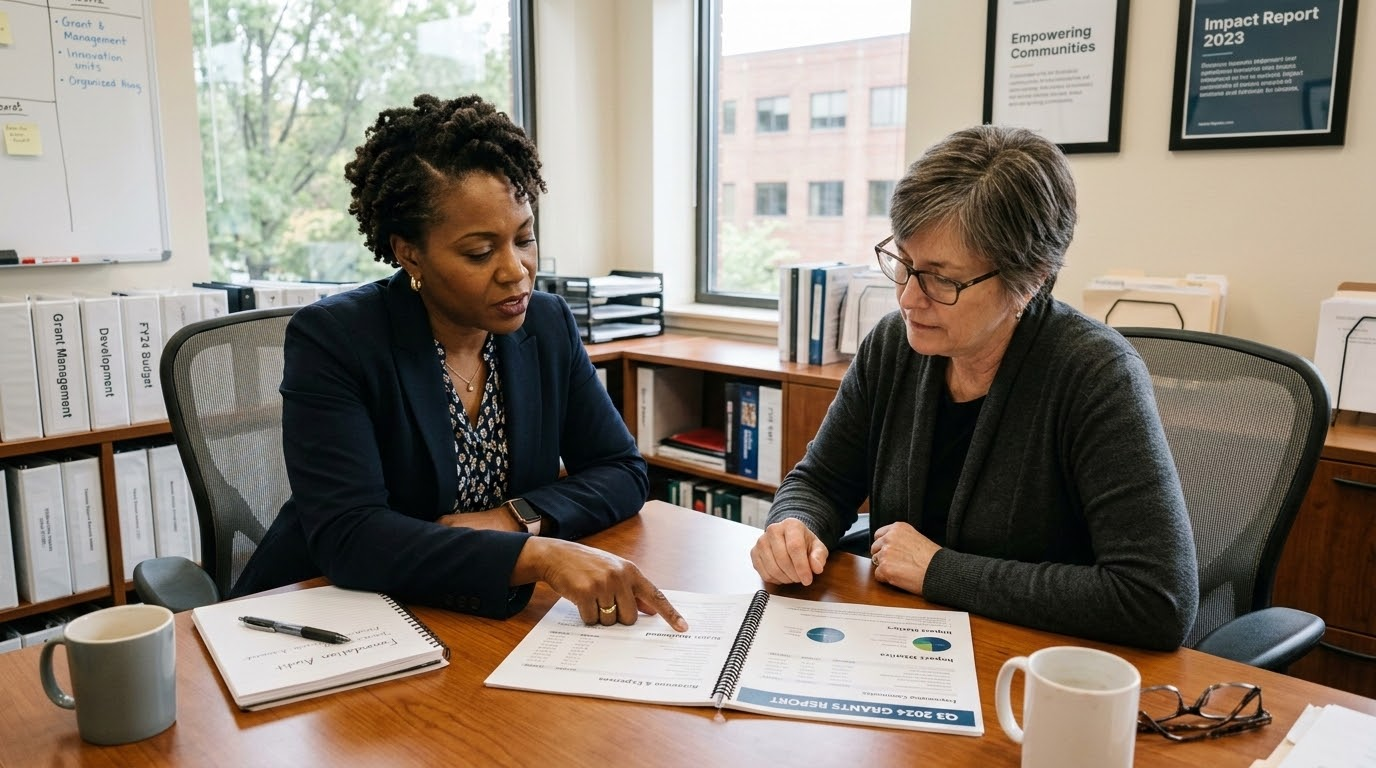
The Real Question Behind the Search
When nonprofit leaders ask me what foundations look for before trusting them with money, they usually expect me to talk about the mission. Or the program. Or the community need.
And yes — mission matters. Program design matters. Community need matters. But those are not the things that most commonly cause a nonprofit to lose a funder's trust before a relationship even begins.
What I tell every nonprofit leader I work with in Moreno Valley, the Inland Empire, and Riverside County is this: foundations look closely at your financials, your governance records, and your ability to document what you said you would do. Good record-keeping is not a bureaucratic formality. It is the foundation of funder trust. And if you lack the data to prove you can handle program deliverables, it is considered a major red flag — regardless of how compelling your mission sounds.
What Funder Trust Actually Means From a Document Standpoint
Trust, from a funder's perspective, is not a feeling. It is a calculation based on evidence. A foundation program officer reviewing your application is asking a specific set of questions — and they are looking for documentary answers to each one.
Can this organization prove it exists and operates legally? Can it demonstrate responsible financial management? Does it have a board that is actually governing the organization? Does it have a documented program with defined outcomes? Can it show that its work has produced results in the past?
These questions are answered not by your passion or your narrative — but by your documents. Organizations that can produce those documents quickly, accurately, and completely are the ones that earn funder trust. Organizations that cannot are the ones that raise red flags, even when their programs are doing real work in the community.
The Five Trust Pillars Foundations Evaluate Before Releasing Funds
| Trust Pillar | What Funders Are Assessing | Documents That Answer the Question |
|---|---|---|
| Legal Legitimacy | Does this organization exist as a legally formed, tax-exempt entity? | Articles of Incorporation, IRS Determination Letter, California FTB State Exemption, Attorney General Registry Status |
| Financial Credibility | Can this organization handle money responsibly and account for how it is used? | 990 Tax Returns, Audited Financial Statements (at higher thresholds), Operating Budget, Program Budget, Profit and Loss Statements |
| Governance Accountability | Is there a real board governing this organization — or just one person running everything? | Board Roster (current), Board Meeting Minutes, Conflict of Interest Policy, Bylaws (current) |
| Program Clarity | Does the organization have a documented, coherent program with defined activities and outcomes? | Written Program Description, Work Plan, Logic Model, Expected Outcomes, Program Budget |
| Transparency and Verification | Can this organization be independently verified as credible and accountable? | Active Candid / GuideStar Profile, 990 visibility, California Registry Active Status, SAM.gov Registration (if federal) |
Funders do not evaluate these pillars one at a time. They look at all of them together. A strong program with weak financials, or solid financials with missing governance records, creates doubt regardless of which pillar is strong.
Why Financials Are the First Place Funders Look
When I work with nonprofit leaders preparing for their first serious grant application, I start with the financial documents — because that is where funders start too.
Foundations look closely at 990 tax returns and audited financial statements to establish credibility and ensure the organization is solid enough to use the money exactly as promised. These documents tell a funder several things at once: whether the organization is filing its required tax returns on time, how its revenues and expenses are structured, whether it is financially stable or fragile, and whether its financial reporting is organized and transparent.
Keeping good financial records is essential. If you lack the data to prove you can handle program deliverables, it is considered a major red flag. This is not a matter of opinion among funders — it is consistent across private foundations, community foundations, and government funders alike.
What the 990 Tells a Funder
The IRS Form 990 is a public document. Funders can see it on Candid, on ProPublica, and through various nonprofit databases. It shows your organization's revenue, expenses, program descriptions, executive compensation, and governance practices. A nonprofit that is behind on its 990 filings — or that has never filed because it believed its revenues were too small — is sending a signal that its financial record-keeping is not in order. Small nonprofits with gross receipts under certain thresholds may file the 990-N e-Postcard or the 990-EZ rather than the full 990.
When Audited Financial Statements Are Expected
Once a nonprofit reaches a certain threshold — generally around $50,000 or more in annual revenues — having completed 990s and an audited financial statement becomes highly recommended before applying for most serious grants. At higher revenue levels, many funders require audited statements as part of the application package. Organizations that are approaching grant funding without this documentation are at a disadvantage in competitive review processes.
Why Governance Records Matter as Much as Financials
Financial credibility gets a lot of attention in grant readiness conversations. Governance records get less — but they matter just as much to experienced funders.
A funder looking at your board roster wants to see current, named board members with diverse professional backgrounds. A board of three people, all of whom are family members of the founder, raises different questions than a board of seven community leaders with backgrounds in education, finance, law, and public health.
Board meeting minutes are part of your corporate record book — a public document — and they serve as evidence that your organization is actually being governed. They show that the board is meeting, that decisions are being documented, that financial oversight is happening, and that grant activity is being tracked. A nonprofit that cannot produce board minutes has no documented proof that governance is functioning.
Your bylaws, conflict of interest policy, and other governance documents round out this picture. Funders want to see that your organization has written rules, that board members are held to ethical standards, and that the organization is not structured in a way that creates conflicts between governance and program delivery.
Program Clarity Is Not Optional — It Is the Standard
Even a compelling program description loses credibility if it is not backed by documented structure. Funders want to see a written program description that tells them who you serve, what you do, when and where you do it, and why your approach works. They want a work plan that shows how the program will be executed. They want expected outcomes that are specific and measurable — not aspirational language about helping families.
I see many nonprofits in the Inland Empire with genuinely impactful programs that struggle to get funded because the program has never been fully documented. The program exists in practice. It does not exist on paper in a way that a funder reviewer can evaluate against a scoring rubric.
Good program documentation does not just support your grant application. It protects your program. It ensures that someone other than the founder can describe, deliver, and account for what the organization does — which is exactly what funders are looking for when they are deciding whether to trust an organization with their money.
What Funders See When They Check Your Candid Profile
Many regional funders — including community foundations and family foundations throughout the Inland Empire — use Candid to conduct initial due diligence before reviewing applications. What they see when they search your organization tells them a great deal before they open a single page of your proposal.
An active Candid profile with a Seal of Transparency shows that your organization has claimed its profile, completed its information, and made its financial documents publicly accessible. A blank or unclaimed profile raises questions. An outdated profile with stale financial data raises concerns about whether the organization is actively maintained.
This is one of the simplest credibility signals your organization can establish — and one of the most commonly overlooked by nonprofits that are focused on writing proposals before they have built their verification foundation.
Red Flags That Cause Funders to Lose Trust Before the Proposal Is Read
These are the signals that put an application in jeopardy before the narrative is ever evaluated.
| Red Flag | What It Signals to a Funder |
|---|---|
| 990 filings are missing, late, or inconsistent | Financial management is disorganized or the organization is not maintaining compliance |
| California registry status is delinquent or unknown | The organization may not be legally authorized to receive charitable contributions in California |
| Candid profile is blank or unclaimed | The organization is not maintaining public transparency — a basic funder expectation |
| Board roster lists only the founder or family members | Governance may not be independent — raises conflict of interest concerns |
| No board meeting minutes exist | There is no documented evidence that the organization is being governed |
| Program description exists only verbally | Funder cannot evaluate the program — it has not been formalized or documented |
| Financial records are informal or unorganized | Funder cannot assess whether grant funds will be managed responsibly |
| Conflict of interest policy is absent | IRS expects this document — its absence suggests governance gaps |
What to Have Organized Before You Approach a Funder
The goal is not to have perfect documents. The goal is to have complete, current, and organized documents that answer a funder's trust questions before they have to ask them.
- Active 501(c)(3) status with IRS determination letter
- California state tax-exempt status (FTB) — current and in good standing
- Active registration with the California Attorney General’s Registry of Charitable Trusts
- 990 filings current and publicly visible through Candid
- Active Candid profile with Seal of Transparency (or working toward it)
- Current board roster with named members and roles
- Board meeting minutes organized and available
- Current bylaws and conflict of interest policy
- Written program description with work plan and expected outcomes
- Operating budget and program-specific budget
- Profit and loss statements or financial activity summary
Quick Answers
Do all foundations require audited financial statements?
What if my nonprofit is small and does not have much financial history?
Why do funders check the California Attorney General Registry?
What is a 990 and does my small nonprofit need to file one?
How does a Candid Seal of Transparency help with grant applications?
What financial records does a nonprofit need if it is under $50,000 in annual revenues?
Funder Trust Is Built Before the Proposal Is Written
Before you spend time, money, or energy pursuing your next grant, take The Document Pro’s Grant Readiness Checklist. It will help you see whether your financial records, governance documents, compliance status, and program documentation are in the condition funders expect — before you apply.
Disclaimer: This article is for educational and organizational planning purposes only. It does not provide legal, tax, financial, or grant approval advice and does not guarantee funding, eligibility, or funder acceptance.